
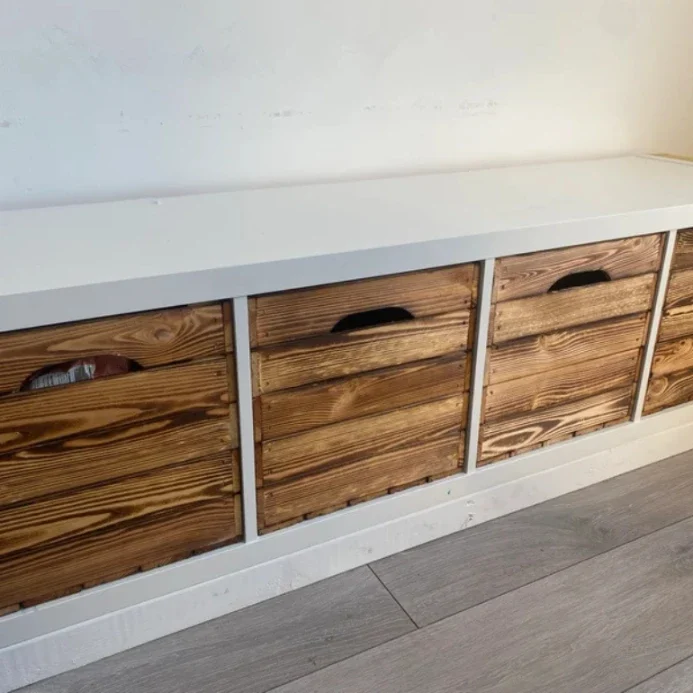
KALLAX boxes are the first thing you start looking for once the cube shelving unit is standing in the room and more and more odds and ends are piling up in its compartments. Open shelves only look good for a while – then come the cables, chargers, toys, hats and paperwork that are just begging to be tidied away. The right insert turns the shelving unit into a proper chest of drawers, and the whole room instantly looks calmer.
In this guide we show you the size of an IKEA KALLAX compartment and which box fits it, how cardboard, fabric, plastic, wicker and wooden inserts differ, and when a wooden crate genuinely makes sense – and when a cheaper fabric box will do the job perfectly well. You will also find ready-made crate layouts, ideas for every room and answers to the most common questions.
We have been making crates from pine wood in our family workshop since 2016, and we ship them from Sandomierz. Boxes for cube shelving are one of the products you ask about most often – especially in September, when school starts, and in January, when everyone has a big clear-out after the holidays.
What size is a KALLAX compartment and which box fits it
Each compartment of the IKEA KALLAX shelving unit measures roughly 33×33 cm on the inside, and it is around 38–39 cm deep. This size is the same whether you have the version with four, eight or sixteen compartments – what matters is the single cube. So when you are looking for a KALLAX box, check the width and height of the front first, and only then the depth.
The box should be slightly smaller than the opening so it slides in and out without tugging. A few millimetres of clearance on each side is exactly what you need. If the insert is a tight fit, it will catch on the edge of the board every time you pull it out, and after a few weeks you will see scuff marks.
How to measure the compartment before you buy
Even if you know which shelving unit you have, take two minutes to measure. Boards can vary slightly, and the shelves in older units sometimes sag a little.
- Measure the internal width of the compartment, i.e. from the inner edge of one board to the other – ideally at the front and at the back.
- Measure the height, also in two places. If the unit has been standing for years and is heavily loaded, the middle of the shelf may be slightly lower.
- Measure the depth from the front edge to the back panel, or to the wall the unit stands against (if it has no back).
- Subtract a few millimetres of clearance from the smallest measurement – and compare boxes against that size.
Depth – can the box stick out or be shallower
A box that is shallower than the compartment is no problem – there will be a little space left at the back, and the front will sit flush with the edge of the unit if you push it all the way in and pull it back slightly. It is worse when the insert is deeper than the compartment: then it sticks out, spoils the neat line of fronts and is easy to catch with your foot. Our crates for KALLAX shelving measure 33×33×38 cm, so they match the typical depth of a cube.

Types of KALLAX inserts – a comparison
KALLAX inserts fall into five groups. Each has its place and none is best for everything. Below we briefly describe each of them, and at the end we sum everything up in a table.
Cardboard boxes
The cheapest and lightest option. They work well for documents, photos and things you hardly ever touch. They don’t cope well with damp, frequent use or children’s hands – the corners quickly get crushed, and cut-out cardboard handles tear when the contents are heavier.
Fabric boxes
The most popular choice – soft, foldable fabric boxes on a stiffer frame, often sold alongside the shelving unit. They are light, quiet and cheap, with a handle or cut-out at the front. Their weak point is that they lose their shape over time: the sides bulge, the bottom sags under heavier items, and the fabric collects dust and pet hair.
Plastic containers
Practical where being wipe-clean matters – in a utility room, garage, sometimes in a small child’s room. They are often transparent, so you can see what’s inside. In a living room or bedroom, though, they look very “warehouse” and don’t suit every interior.
Wicker and seagrass baskets
Woven shelf baskets bring warmth and natural texture. They are pretty, but their edges are irregular, so they rarely fit the compartment perfectly. The weave can snag jumpers and delicate fabrics, and small items fall into the gaps.
Wooden crates
Rigid, stable and the most durable of all. They don’t change shape, they cope with being pulled out frequently, you can carry them with their contents, and years later they still look smart. They are heavier and more expensive than fabric boxes – and that is a fair price for not having to replace them every two years.
| Type of insert | Durability | Look | Approximate price | Best for |
|---|---|---|---|---|
| Type of insertCardboard box | Durabilitylow – crushes easily, dislikes damp | Lookplain, office-like | Approximate pricelowest | Best fordocuments, photos, archives |
| Type of insertFabric box | Durabilitymedium – loses its shape over time | Looksoft, plenty of colours | Approximate pricelow | Best forlight clothes, scarves, children’s bedding |
| Type of insertPlastic container | Durabilitygood, wipe-clean | Looktechnical, “warehouse” | Approximate pricelow to medium | Best forutility room, garage, building blocks |
| Type of insertWicker basket | Durabilitymedium – the weave wears | Lookwarm, natural | Approximate pricemedium | Best forblankets, towels, boho-style living room |
| Type of insertWooden crate | Durabilityhighest – rigid, keeps its shape | Looknatural or rustic, timeless | Approximate pricemedium to higher (ours from PLN 139) | Best fortoys, shoes, books, tools, everyday use |
If you are thinking more broadly about what to keep things in around the whole home, take a look at our guide to storage containers – there we compare more sizes and materials, not just for cube shelving.
When a wooden crate makes sense, and when a fabric box will do
We sell wooden crates, but we won’t pretend they are the best choice in every situation. There are compartments where wood would be wasted, and there are others where a fabric box won’t last even a year.
Choose wood when…
- You pull the insert out every day – for example in the hallway, a child’s room or the office. Rigid sides don’t give when you grab them.
- You store heavier things – books, building blocks, shoes, tools, ring binders. The bottom of a fabric box soon sags under them.
- The shelving unit is on display – in the living room, crates act like furniture fronts. Wood gives the effect of a chest of drawers rather than “boxes on a shelf”.
- You want to carry the contents around – a crate of building blocks can be taken over to the rug, and a crate of hats can be put by the door while you pack.
- Durability matters to you – a pine crate doesn’t bulge or fray, and years later you can move it to the cellar, garage or balcony.
Fabric will do when…
- You keep light things in the compartment: scarves, underwear, bedding, towels.
- You open the box once every few weeks – for example for Christmas decorations or keepsakes.
- The shelving unit stands where looks matter less, e.g. in a walk-in wardrobe behind a door.
- Your budget is tight and there are lots of compartments to fill – then it makes sense to use wood only where it works hardest.
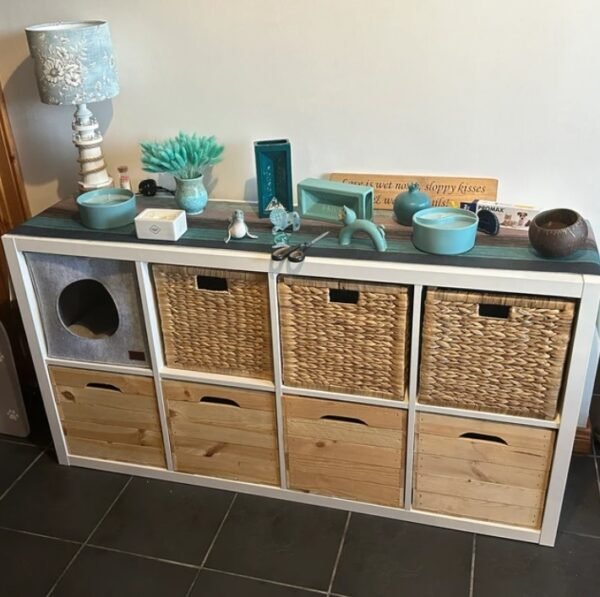
In practice, many people combine both: wooden crates in the bottom row and in the most frequently used spots, and fabric boxes higher up for light items. It’s a good compromise between price and convenience.
Crates made to fit a cube shelving compartment
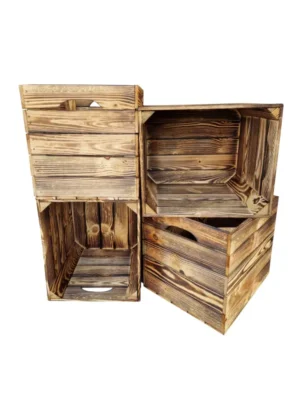

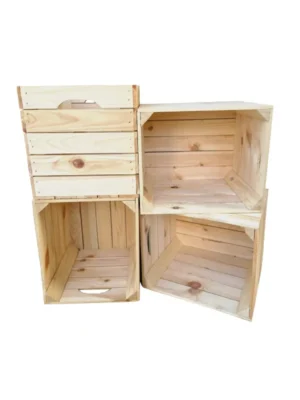


Crates with or without handles
We hear this question about KALLAX boxes very often. The difference looks minor, but in everyday use it is clear.
Crate without handles
The 33×33×38 cm model without handles has smooth sides and a simple, calm look. It works well when you pull the insert out less often or when you want the shelving unit to look minimalist. You grab the crate by its top edge – with light contents, that is perfectly sufficient.
Crate with cut-out handles
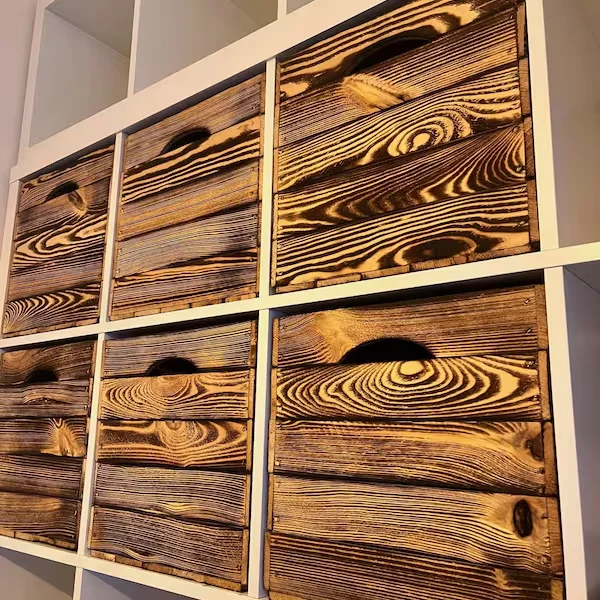
KALLAX crates with handles have cut-out openings you can easily slip your fingers into. You pull them out in one movement, like a drawer, and a full crate is comfortable to carry with both hands. It’s the best choice for a child’s room, the hallway and anywhere the insert is used several times a day. The handles also provide a little ventilation – useful for shoes and sports kit.
What about crates with lids?
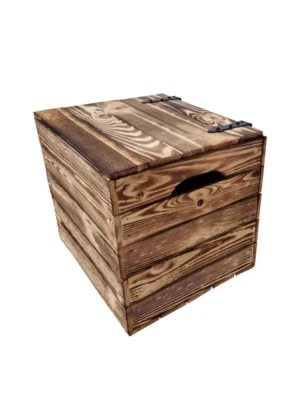
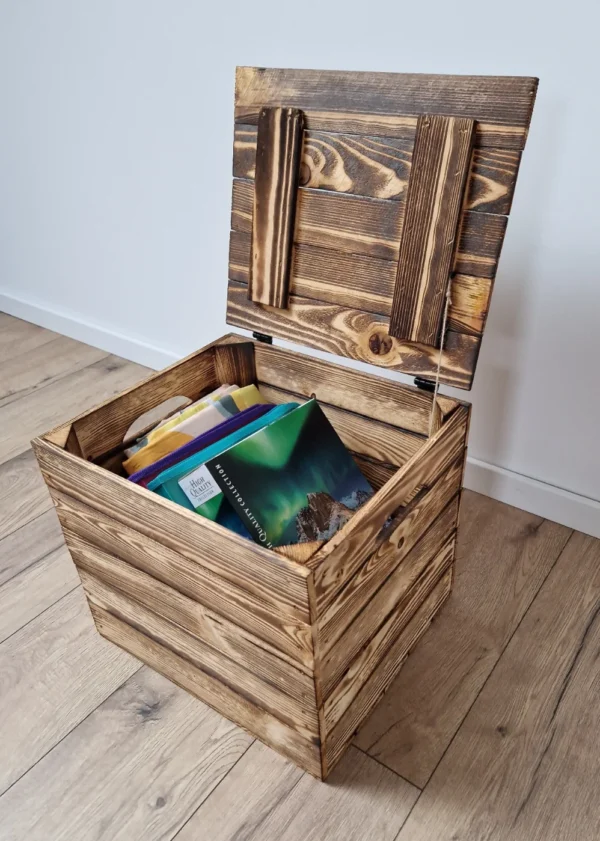
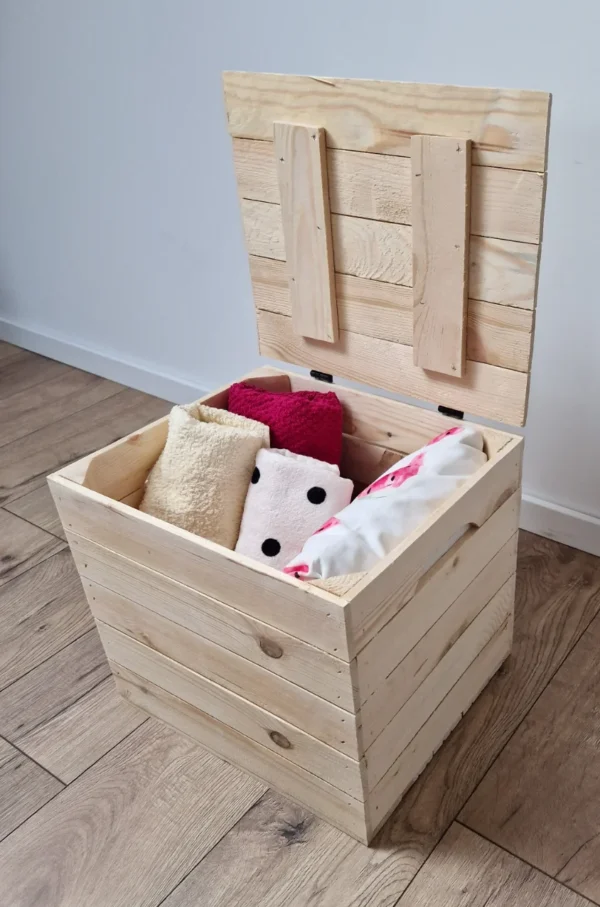
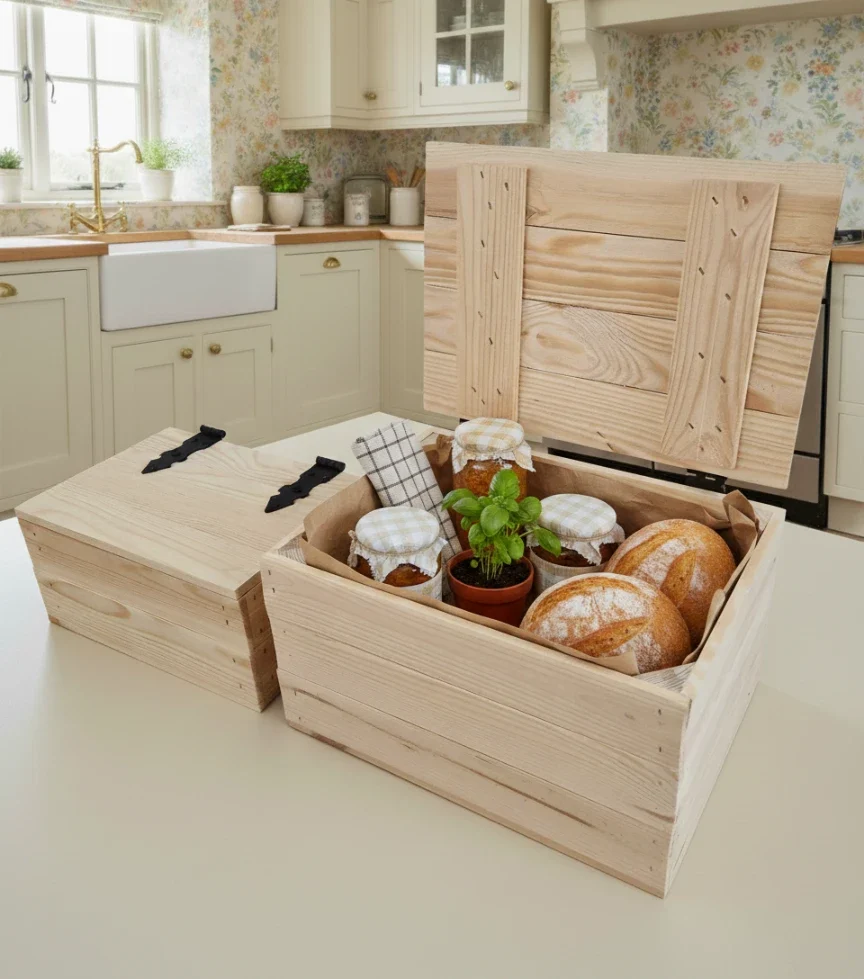
We also offer crates with handles and a lid, 33×33×39 cm, in a natural finish and in a burnt finish. With a depth of approx. 39 cm, they work as separate containers next to the shelving unit or on top of it – for example on the top surface, where the lid keeps dust off the contents. If you are thinking of sliding them inside, though, measure the compartment before you buy: every centimetre counts, and the lid still needs room to be lifted.
Crates with lids are a good solution for seasonal items: winter hats in summer, Christmas tree decorations for the rest of the year, spare blankets. If you are looking for something bigger for bedding and duvets, read our guide on how to choose a bedding chest.
Natural or burnt – how to match the crate colour to your shelving unit
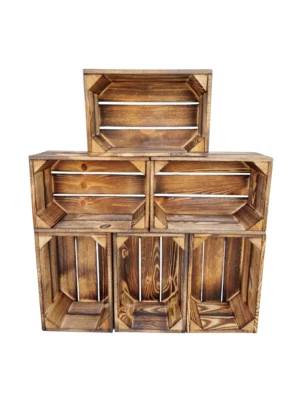
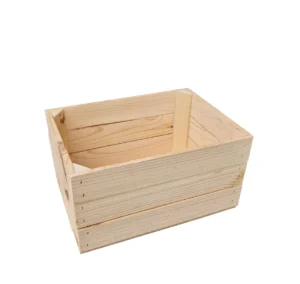
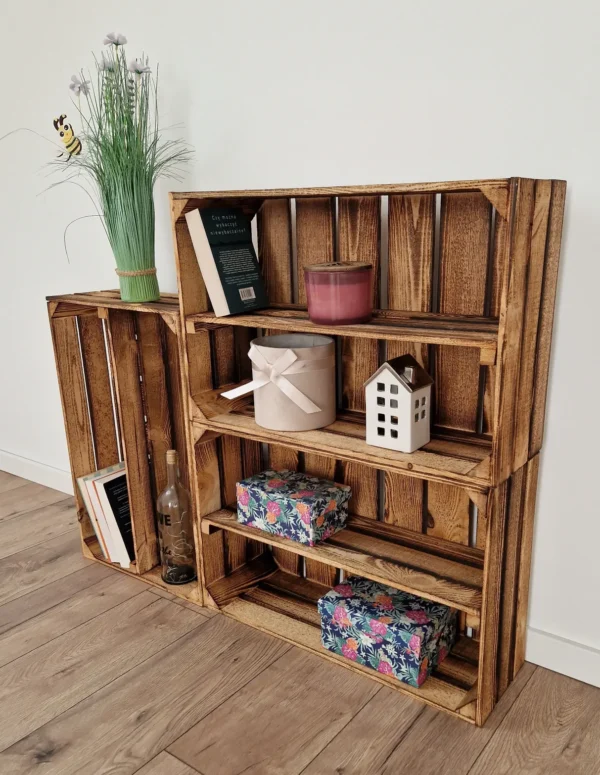
Our crates come in two finishes. Natural is light, sanded pine. Burnt crates are darker, with a clearly brought-out grain, giving a rustic, slightly industrial look. Both look good in cube shelving – it’s just a question of the effect you want.
| Shelving unit colour | Natural pine | Burnt pine | Our suggestion |
|---|---|---|---|
| Shelving unit colourWhite | Natural pinelight, Scandinavian, calm | Burnt pinestrong contrast, loft look | Our suggestionnatural for light interiors and children’s rooms, burnt when you want a bold accent |
| Shelving unit colourBlack / black-brown | Natural pinea clear, light accent against a dark background | Burnt pinetone on tone, elegant and cohesive | Our suggestionburnt if the unit should “disappear” into the wall; natural if it should be a feature |
| Shelving unit colourOak effect (light) | Natural pinevery cohesive, wood with wood | Burnt pinewarm, cosy contrast | Our suggestionboth work; natural for a uniform look |
| Shelving unit colourColoured front or wall | Natural pinea neutral base that doesn’t clash with the colour | Burnt pineheavier, but interesting with dark shades | Our suggestionnatural is the safer bet, burnt with bottle green or navy |
Mixing finishes
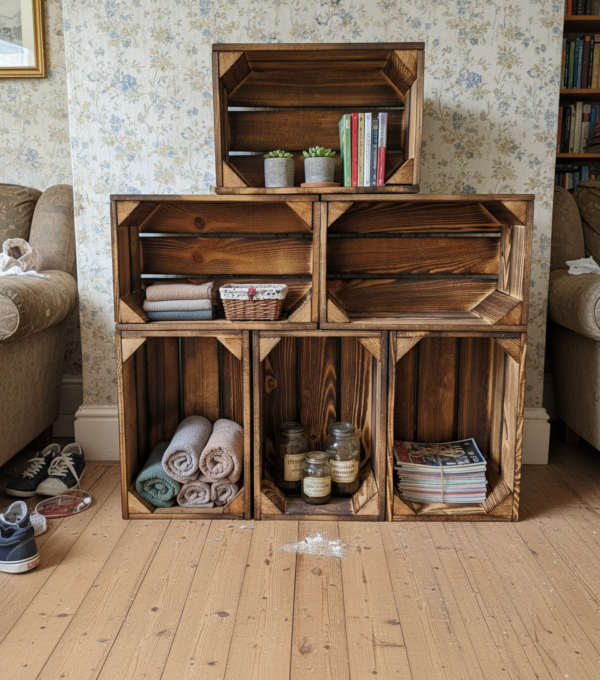
There is nothing stopping you from combining light and dark crates in one unit. It looks best in a chequerboard layout or in rows: for example burnt at the bottom, natural higher up. Avoid scattering them at random, though – that makes the shelving unit look chaotic.
Remember too that pine is a natural material. Each crate has a slightly different pattern of grain and knots, and natural crates darken slightly over time in the light. That isn’t a flaw – it’s the charm of wood.

How many crates to buy – tried-and-tested layouts
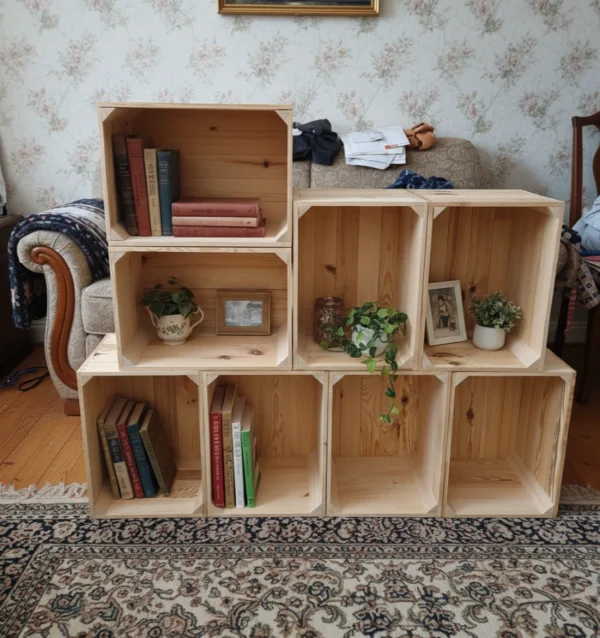
The most common mistake with cube shelving inserts? Filling every compartment at once. A shelving unit completely filled with boxes looks heavy and loses what’s best about it – the chance to display books, plants or keepsakes. Here are the layouts that work best.
Bottom row
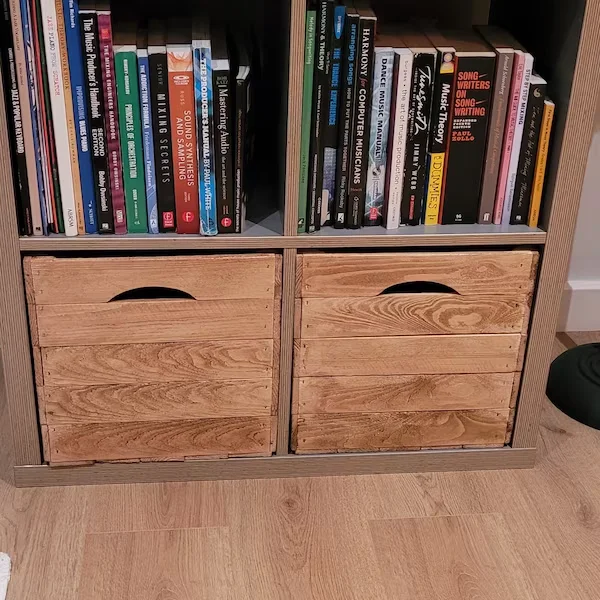
Crates only on the lowest level, with open shelves above. This is the most practical layout: at the bottom you hide heavier, less decorative items, and at eye level you display the things you love. It works brilliantly in the living room, in a child’s room (children can reach the crates themselves) and in the hallway.
Every other compartment
Crates alternating with open shelves in every row. The unit looks light and rhythmic, and you still have plenty of concealed space. A good choice for larger units, where a full row of crates would look monotonous.
Chequerboard
The “every other compartment” layout, shifted along in each row. It looks decorative, especially when you combine natural and burnt crates, or crates with open shelves full of books. It works best in 4×4 and 2×4 units.
A column or a full unit
Every compartment in one column (e.g. next to a desk, for paperwork) or a full set in a whole small unit. Filling everything makes sense in a walk-in wardrobe, utility room or child’s room, where hiding things away matters more than display.
| Shelving unit size | Bottom row | Every other / chequerboard | Fully filled |
|---|---|---|---|
| Shelving unit size1×4 (narrow, vertical) | Bottom row1 crate | Every other / chequerboard2 crates | Fully filled4 crates |
| Shelving unit size2×2 | Bottom row2 crates | Every other / chequerboard2 crates | Fully filled4 crates |
| Shelving unit size2×4 | Bottom row2 (vertical) or 4 (horizontal) | Every other / chequerboard4 crates | Fully filled8 crates |
| Shelving unit size4×4 | Bottom row4 crates | Every other / chequerboard8 crates | Fully filled16 crates |
KALLAX box ideas for every room
The same cube shelving unit can play a completely different role depending on the room. Below we have gathered ideas that work in our customers’ homes and in our own.
Living room
In the living room, crates hide the things that usually pile up on the coffee table: remotes, chargers, board games, playing cards, magazines, blankets for evenings in front of the TV. A bottom row hidden behind crates and open shelves above – with books, plants and photos – is a classic that won’t get boring for years. If you have a horizontal unit under the TV, crates with handles can replace a TV cabinet.
Children’s room – KALLAX boxes for kids
This is where wooden crates really come into their own. Building blocks, cars, dolls, soft toys and drawing supplies all have their place, and children can pull a crate out themselves, tip the toys onto the rug and – at least in theory – put them back again. The rigid sides don’t cave in when a little one leans on them, and the crate won’t buckle if someone stands on it.
- Choose the model with handles – small hands find a cut-out opening easier to grip than the top edge.
- Put the crates in the bottom row, within a child’s reach. Leave the higher compartments for things an adult reaches for.
- Attach a picture of what’s inside to each crate (e.g. blocks, cars, books) – younger children learn to tidy up faster.
- Make sure the crates aren’t overloaded – a lighter one is easier and safer to pull out.
- Fix the shelving unit to the wall in line with the manufacturer’s instructions – this matters for every piece of furniture in a child’s room.
For smaller treasures – crayons, modelling clay, figures – our small crates, 30×20×15 cm, are ideal. Placed on a desk or on top of the shelving unit, they organise the things that would get lost in a large crate.
Hallway – hats, scarves, gloves and shoes
A cube shelving unit in the hallway is a great alternative to a chest of drawers. Everyone in the household can have their own crate for hats, scarves and gloves, and everyday shoes fit in the bottom row. In the Polish climate, where winter accessories pile up in the hallway from October to March, this really makes a difference.
Crates with handles are better here than solid boxes – the openings let in a little air, so wet gloves or trainers aren’t shut away in a stuffy space. Even so, dry wet things first and only then put them away. If you need space specifically for footwear, take a look at our crate shoe racks too.
Office and home study
Ring binders, envelopes, bills, appliance manuals, spare printer paper – it all weighs more than you’d think and soon bends the bottom of fabric boxes. A wooden crate will take it without any trouble. Arrange the crates in a column next to your desk, label them (e.g. “bills”, “car”, “warranties”), and finding a document will take you a few seconds.
A smaller crate for stationery is handy on the desk – 35×25×19 cm crates will hold pens, notebooks, cables and headphones. Many people also keep a 39×29×24 cm crate next to the shelving unit for current paperwork that hasn’t made it into a binder yet.
Walk-in wardrobe and bedroom
In a walk-in wardrobe, cube shelving replaces drawers: you keep T-shirts, jumpers, underwear, belts and handbags in the crates. Lined crates work well here – just put a cotton bag, a piece of linen or a fabric liner inside so delicate fabrics don’t touch the wood. That way you combine the durability of a crate with the softness of fabric.

Smaller crates for the desk, worktop and odds and ends
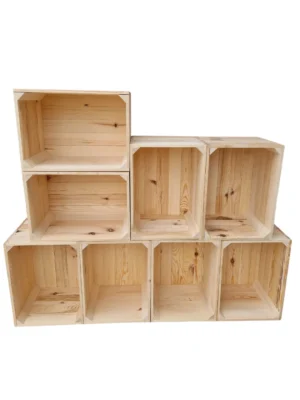
Smaller crates in a compartment – does it make sense?
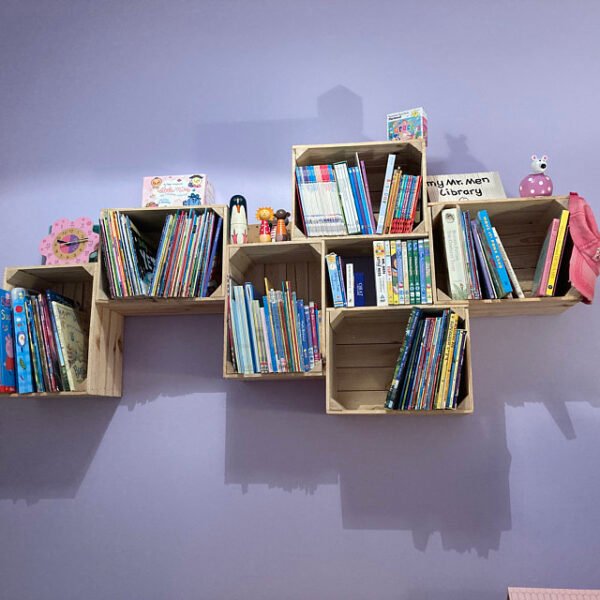
Not every compartment needs one big box. Sometimes it’s better to divide it into smaller containers, especially when you store small items: sewing kit, batteries, cosmetics, spices, pet accessories. The small 30×20×15 cm crate is low enough that, slid in lengthwise, it leaves plenty of space above it – in theory, two will fit stacked one on top of the other.
To be honest, though: smaller crates aren’t made to the compartment size, so there will be free space around them, and the front of the unit won’t be as even as with dedicated 33×33 crates. Before you order, measure your compartment and compare it with the crate dimensions. More often than not, the smaller models work better on top of the unit, on a desk or in a wardrobe than inside the cube.
If you are unsure which size suits what, our guide on which wooden crate to choose will help – there we list all the sizes with examples of how to use them.
Caring for wooden crates
Pine crates don’t need much, but a few simple habits will keep them looking good for many years.
- Dust – wipe with a dry or slightly damp, well wrung-out cloth. Don’t leave water standing on the surface.
- Marks – small marks on natural pine can be removed gently with fine sandpaper, working along the grain.
- Damp – don’t put wet shoes and gloves in the crates, and don’t stand them right next to a radiator. Wood is happiest at a stable temperature.
- Light – natural crates darken slightly in the sun over time. If an even colour matters to you, swap them around every so often.
- Delicate fabrics – for jumpers and silk, put a cotton bag or fabric liner inside.
- Finish – if you like, you can protect a natural crate yourself with wood oil or wax. Test the result on the underside of the crate first.
How to order boxes for KALLAX shelving
Ordering is simple and takes just a few minutes:
- Measure the compartment – check the width, height and depth as described above.
- Choose a model – without handles, with handles or a crate with a lid to stand next to the unit.
- Choose a finish – natural or burnt, and the number of crates to match the layout you like.
- Add to basket and choose your delivery method – from PLN 9.99: Orlen Paczka, parcel lockers or courier.
- Collect your parcel – the crates arrive ready to use, with no assembly needed. Just unpack them and slide them into the shelving unit.
If you have a question about dimensions, combining finishes or an unusual shelving unit, drop us a message – we’re happy to advise. And if you want to give someone crates as a gift but don’t know what shelving unit they have or what colour their interior is, a gift card sent by email is a good solution.
KALLAX boxes and crates with lids

Frequently asked questions
A compartment in the IKEA KALLAX shelving unit is approx. 33×33 cm and approx. 38–39 cm deep, so the front of the box should be just under 33×33 cm. Our crates for KALLAX shelving measure 33×33×38 cm. Before you buy, it’s worth measuring your own compartment in two places. For everyday use and heavier items – yes, because they don’t lose their shape or sag. For light clothes and things you rarely open, a fabric box is perfectly sufficient and cheaper. With a depth of approx. 39 cm, they work best as separate containers next to the shelving unit or on top of it. If you want to slide them inside, measure the compartment carefully – the lid also needs room to be lifted. Rigid crates with cut-out handles, placed in the bottom row, are best. Children can pull them out easily, and the sides won’t cave in under pressure. Always fix the shelving unit to the wall. In a white shelving unit, natural pine gives a light, Scandinavian look, while burnt pine creates a strong, loft-style contrast. Both finishes look good; the choice depends on whether you want the crates to blend in or stand out. No. The crates arrive ready to use, with no assembly needed – just unpack them and slide them into the shelving unit. Yes, you will find our returns policy on the returns and complaints page. To avoid any hassle, measure the compartment before ordering and compare it with the crate dimensions.What size are KALLAX boxes?
Are wooden crates better than fabric boxes?
Will the 33×33×39 cm crates with lids fit in a compartment?
Which KALLAX boxes should I choose for children?
Natural or burnt – which suits a white shelving unit?
Do the crates need assembling?
Can I return the crates if they don’t fit?
Summary – how to choose KALLAX boxes
Choosing inserts for cube shelving comes down to three questions: what size your compartment is, what you will keep in it and how often you will open it. For light, rarely used items, a fabric box is enough. Wherever the insert works every day – in a child’s room, in the hallway, in the office and on display in the living room – a wooden crate will repay you with durability and a smart look for years.
Start by measuring the compartment and with a few crates in the bottom row. Choose natural pine for light interiors or burnt pine for dark, high-contrast ones. And if you would like a suggestion as to which KALLAX crates will work best in your shelving unit – drop us a message, we’ll be glad to help.

She has been furnishing homes with crates for years — from small studio flats to houses with gardens. She writes about tidiness, storage and decorating ideas that need no renovation.
All articles by this author









Leave a comment